
Last updated: August 2026
Traveling with a dog in a camper van is one of the best things there is, but there’s a fair bit to think about first! The most important things to arrange beforehand are the paperwork, a heat plan, and prevention against Southern European parasites. On top of that, there are of course plenty of other practical things you could sort out along the way.
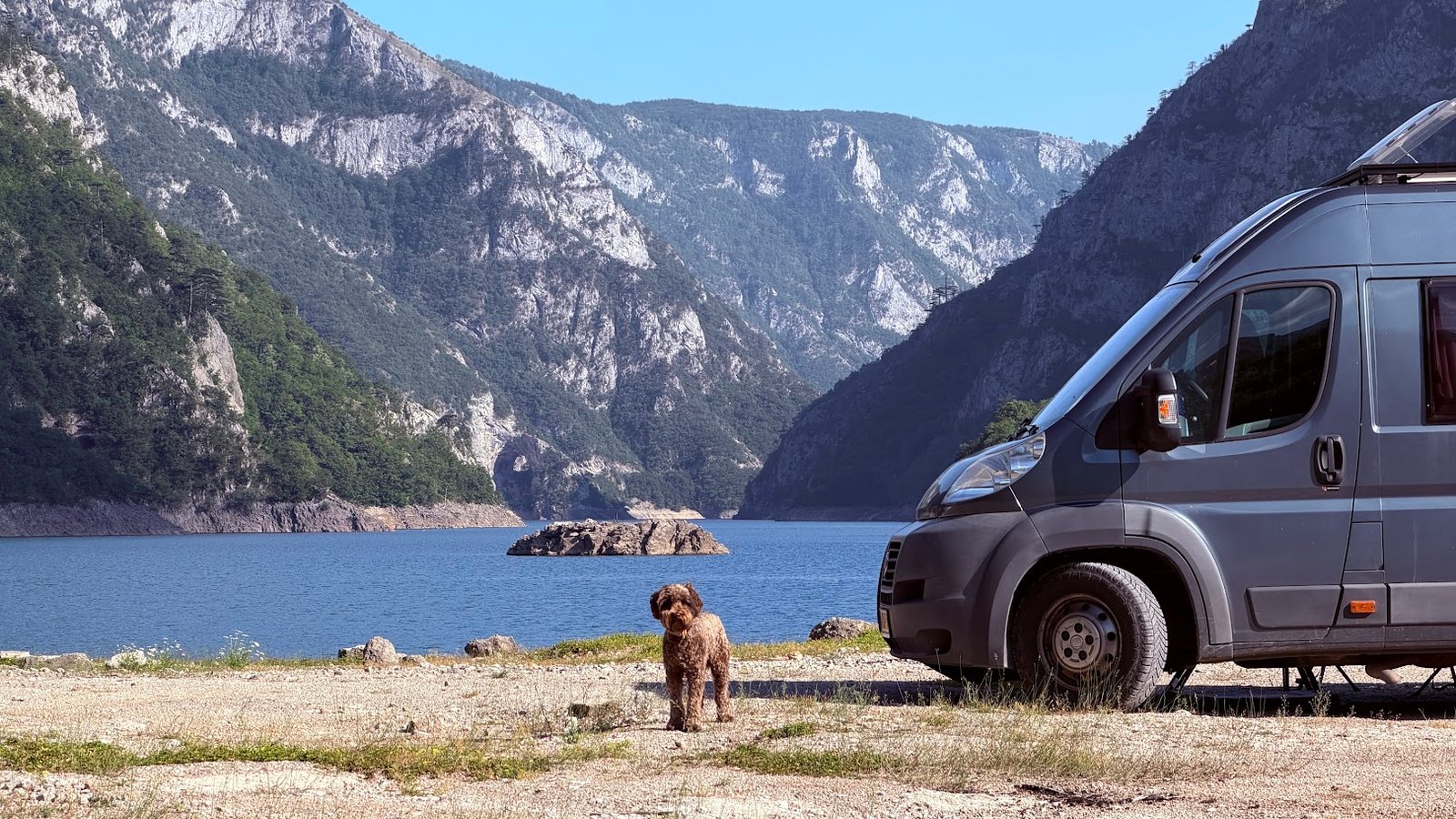
At the time of writing, we’ve been on the road for 4 months with our camper and our labradoodle Bodhi. We take Bodhi everywhere with us: we’ve walked a 120km stretch of the Camino together in Puglia, we do tent treks, and we visit the nicest little towns together.
This blog isn’t the standard checklist of “bring a water bowl”. This is about the things you only find out once you’re already on the road, some of which can no longer be fixed once you’ve crossed the border.
1 – What paperwork do you need to cross the border with your dog?
Below you’ll find all the rules as officially laid down. During our travels through the Balkans (inside/outside the EU) we noticed that customs officers had little to no interest in Bodhi’s documents. But it’s still good to be well informed beforehand – it would be a real shame if you couldn’t get back into the EU with your dog because your documentation or vaccinations weren’t in order!
The rules below may be outdated by the time you read this. We’re also not experts in regulations and documentation. Use the information below mainly to get a rough picture of what’s involved. We’d recommend having everything checked by your vet before you leave, so you know for sure you haven’t missed anything! It’ll save you a lot of research and headaches!
The basics within the EU
If you’re traveling within the EU, you mainly need to have the following in order:
- A chip that meets the ISO standard, implanted before the rabies vaccination is given. If it’s the other way around, the vaccination doesn’t count.
- A valid rabies vaccination. The dog must be at least 12 weeks old at the first shot, and that first shot only becomes valid 21 days later. (No titer test is needed within the EU.)
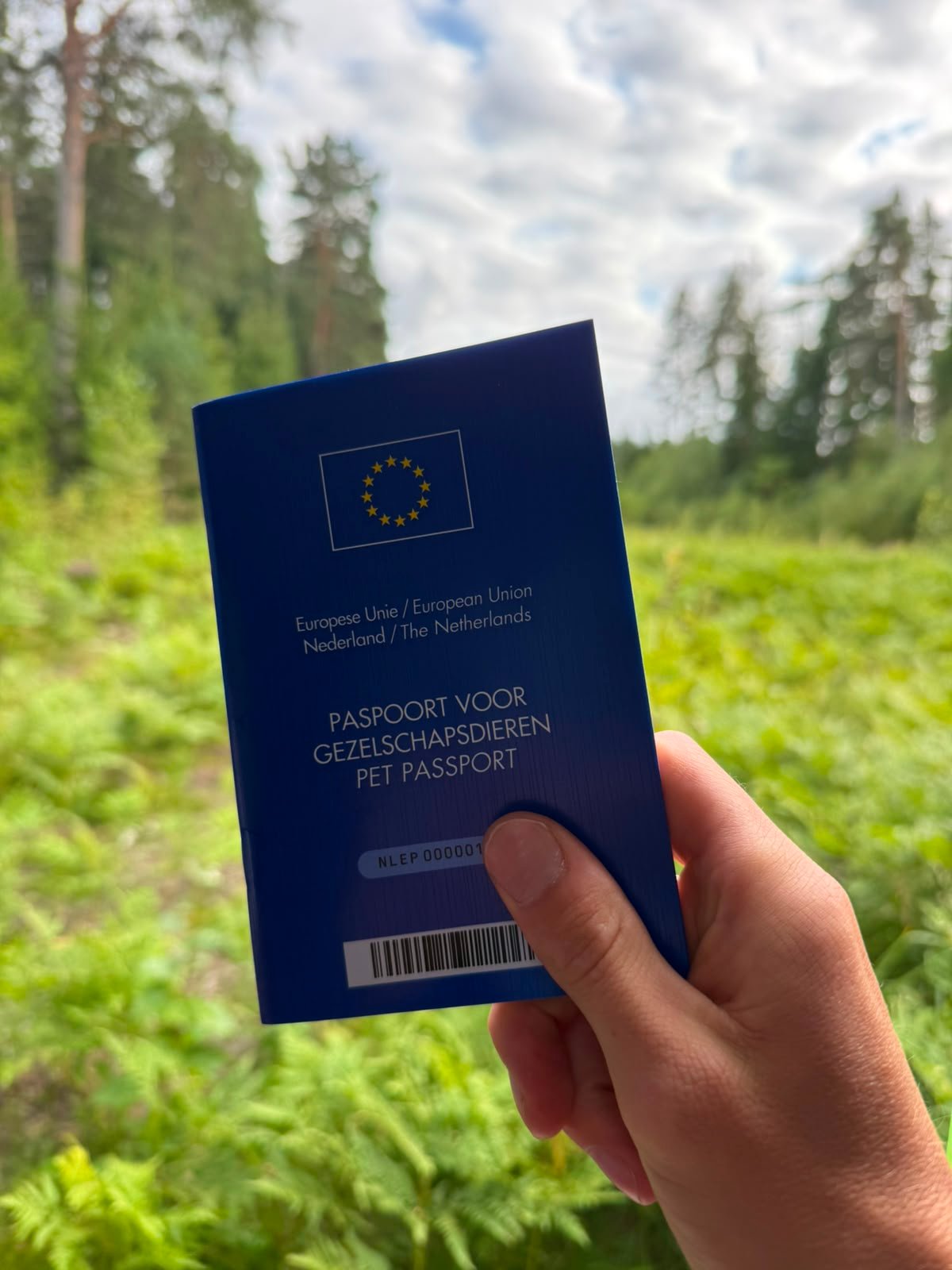
- A European pet passport with details that match the chip registration.
Traveling with your dog outside the EU: the rabies titer test
Once you leave the EU, the game changes – it’s mainly coming back into the EU where things tend to go wrong. The EU splits countries outside the Union into low risk and high risk for rabies. If your dog is coming back from a country not on the low-risk list, a rabies titer test is required: a blood test that shows there are enough antibodies (in other words: that the vaccine actually worked).
This blood test needs to be done before you leave, in the Netherlands. The blood must be drawn at least 30 days after the vaccination. If you only have it drawn abroad, your dog then can’t enter the EU for another 90 days. If you do it beforehand at home, that waiting period doesn’t apply. The test remains valid for life, as long as you keep renewing the rabies vaccination on time.
Import requirements change regularly and differ per country. Before you leave, check licg.nl (import requirements per country, Dutch resource) and nvwa.nl, and discuss it with your vet. What’s written here is how things were when we looked it up, not a guarantee for next year.
Which vaccinations does your dog need for travel?
Besides rabies, it’s wise to keep the standard vaccinations up to date: distemper, hepatitis, parvo, leptospirosis and parainfluenza. Some countries ask about them, and you’ll come across plenty of stray dogs either way. Kennel cough is optional but handy if you’re regularly staying at campsites.
Dog insurance for abroad
Check whether your dog insurance covers you abroad, and for how long. Many policies cover holidays of a few weeks, not a full year of traveling.
2 – Traveling safely with your dog in the camper
The two biggest risks inside the camper itself are heat and a loose dog while driving. Heat can quickly become fatal for a dog, so you need to take sufficient precautions. It’s also important that your dog is secured while driving.
Heat in the camper: the biggest risk for your dog
Just like a car, a camper can get significantly warmer than the outside temperature within a few minutes in the sun. Ventilation, shade and a temperature alarm are therefore more important than any accessory.
This is the most important part of this blog! All the other risks and precautions are annoying. But heat is deadly, and it happens fast…
A camper is an insulated tin box with a lot of glass. A dog cools itself mainly by panting, and that works less well as the air gets warmer and more humid.
In this section we’ll explain what you can do to keep your dog as cool as possible!
Arranging things in advance
There are a number of things you can arrange before your trip:
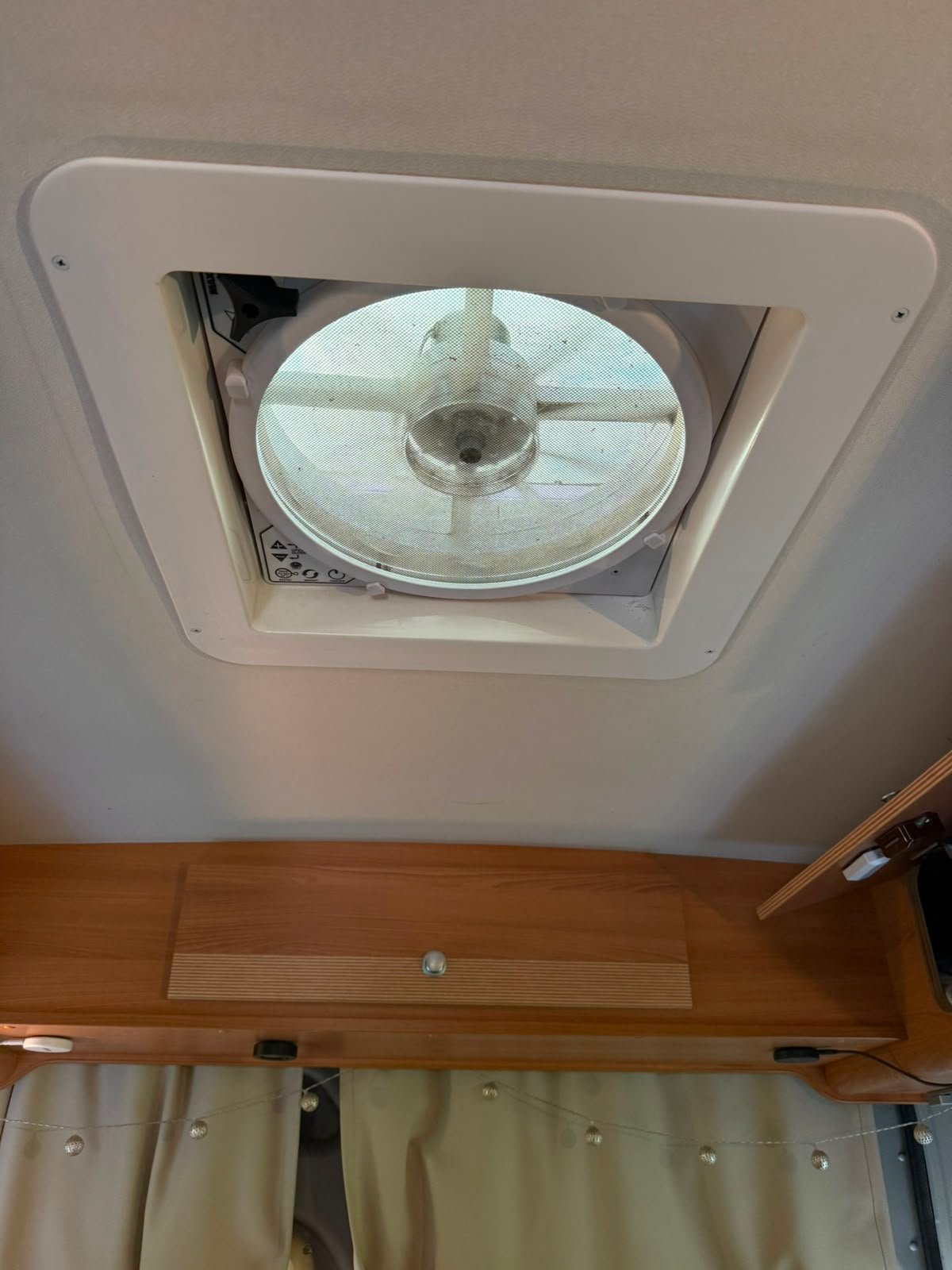
Maxxfan. For us, the most important upgrade to the camper! (not just for Bodhi). The Maxxfan is a roof ventilator that blows warm air from inside to outside (or cool air from outside to inside). The fan runs on 12V and uses very little power, so on hot days ours stays on 24/7. In our case we replaced an existing Dometic skylight with a Maxxfan – a nice Saturday afternoon project. If you’d rather not do it yourself, a camper specialist will typically charge around €700-€800 for the fan plus installation.
The Maxxfan is available in 3 different colors, we went for smoke. It matches our dark-colored van nicely.
Cooling mat. A gel mat that cools by absorbing body heat. It works without power and without water. It’s not an air conditioner and won’t fix a camper that’s too hot, but it gives a dog a cooler spot to lie on.
We figured we could just buy one along the way, but we couldn’t find a gel version anywhere. Luckily we’d brought a sheepskin along from the Netherlands.
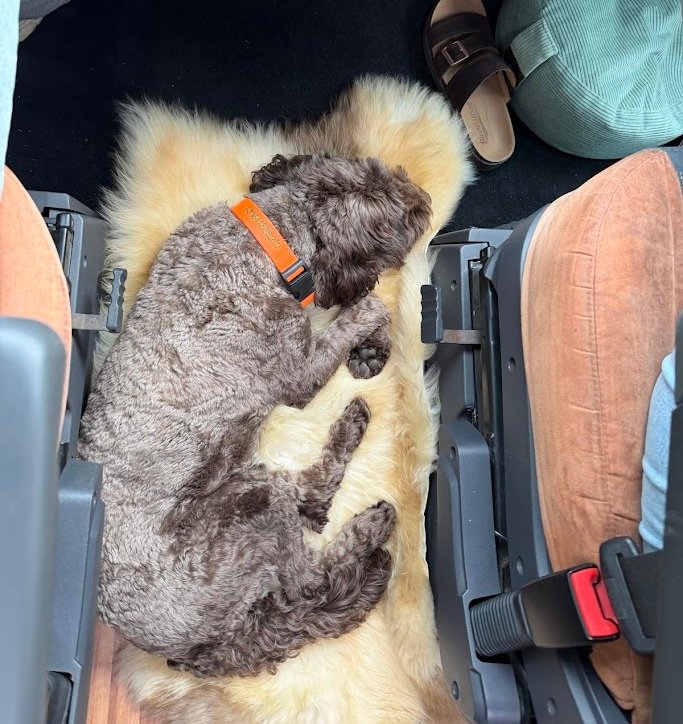
Sheepskin. Instead of a cooling mat you could also go for a sheepskin. We have one lying under the table, and if Bodhi isn’t using it, it’s nice and cozy under our feet! Wool is a natural insulator, so it absorbs body heat well. That means it’s great for your dog in both summer and winter. On top of that, it molds itself to your dog’s body and has a cushioning, pressure-relieving effect that’s good for their joints!
Temperature sensor. If you want to leave your dog in the camper for a bit while you’re out, you’ll want to be able to check on your phone how warm it is inside. We solved this ourselves with a DIY setup using an old phone as a webcam pointed at a thermometer. We use the free app Alfred Camera for this. But there are of course plenty of bluetooth and wifi sensors available online that send an alarm when a set limit is reached.
Air conditioning. With air conditioning you’ll suffer less from high temperatures in your camper, as long as you’re plugged into shore power at a campsite. Most campers have a battery pack and inverter that aren’t big enough to also run the AC when you nip into a town for a bit. That’s partly why we deliberately chose a Maxxfan over air conditioning. We also find that air conditioning makes a lot of noise, which we don’t think is very sociable on a campsite when you’re parked right next to your neighbors.
Practical rules against the heat
A bit obvious perhaps, but we still want to mention them:
- Park/stay overnight in the shade. If you’re staying in one spot for a while, think carefully about where the sun will be for the rest of the day. Ideally, park your camper under natural shade.
- Block out the sun side. Window insulation or curtains on the side facing the sun make a big difference. And if you have an awning, be sure to roll it out for extra shade too.
- Walk early in the morning and in the evening. Give your dog the exercise they need early in the morning and in the evening so they can rest comfortably during the day. On hot days Bodhi prefers to spend the whole day lying under the camper.
- Check the asphalt with your hand. Can you not hold the back of your hand on it for five seconds? Then it’s too hot for paws.
- Water on the go. Make sure your dog always has enough to drink. Tip from us: get sealable containers so water (and kibble) doesn’t fly out while driving. When we’re not with Bodhi at the camper, we use a foldable water bowl.
- Don’t leave your dog alone in the camper unless you’re sure it’ll stay cool. Just because your camper is in the shade right now doesn’t mean it still will be in two hours – the sun keeps moving after all!
- Recognizing temperature differences in the camper. Different spots in your camper can have a different temperature. We all know warm air rises, so the top of your camper is always warmer than the floor. Also, if the front and back of your camper are separated in some way, one area can be much warmer than the other. Example: we close off our ventilated bedroom at night so Bodhi can’t jump on the bed. In the morning, once the sun hits the camper, the bedroom is still comfortable temperature-wise, but the rest of the camper heats up fast! So think carefully about which parts of the camper your dog has access to and how warm it gets there.
- Cooling your dog down with water. You can also easily cool your dog down with water. But it’s important to wet the right spots, not just pour water over them randomly.
The best spots to get wet are:
- The belly and armpits (inside of the legs/groin), where there’s little fur and a lot of blood vessels close to the skin
- Paws and paw pads
- Neck
Recognizing heatstroke in dogs
Despite all these precautions, it’s unfortunately still possible for your dog to get heatstroke. The most important thing is therefore to keep a close eye on your dog!
Heatstroke signals to watch for: heavy and persistent panting, a bright red tongue, drooling, wobbly walking, vomiting, no longer responding. Cool down gradually with lukewarm water, not ice-cold, and get to a vet immediately.
Securing your dog while driving
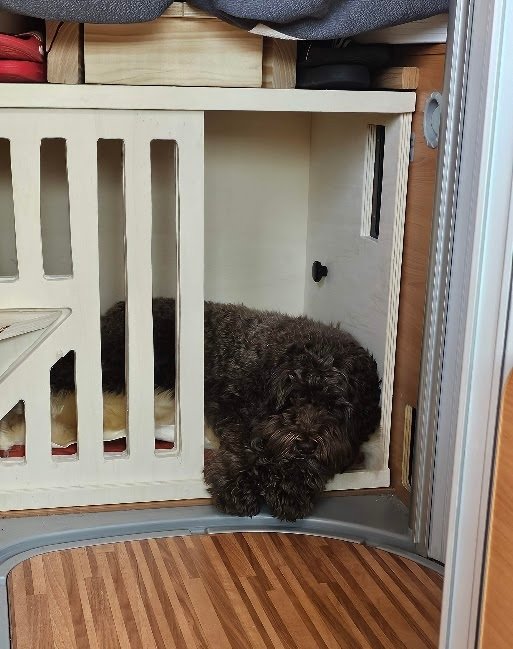
A loose dog in a moving camper is a risk both for the dog and for you. In an emergency stop, a dog suddenly becomes a projectile. In some countries it’s also mandatory that an animal is transported in a way that doesn’t obstruct the driver.
To transport your dog safely and according to the rules, you basically have two options: a crate that’s actually secured to the camper, or a harness that clips into the seatbelt. A regular walking harness is not a safety harness. Look for harnesses that have passed crash testing.
We built a fixed crate in the camper for Bodhi, which he can go into while we’re driving!
3 – Taking your dog on a bike or scooter
With a camper you almost always stay outside the town center, so you often get around by bike or, in our case, an electric scooter. A dog can’t always keep up alongside you, especially not when it’s 25°C+. For us, a dog backpack was the most logical option, since Bodhi is “only” 12kg. There are definitely bigger backpacks that fit heavier dogs up to 23kg, but you have to ask yourself whether you want that much weight on your back. If you do, at least go for a backpack with a hip strap.
Why a backpack and not a basket
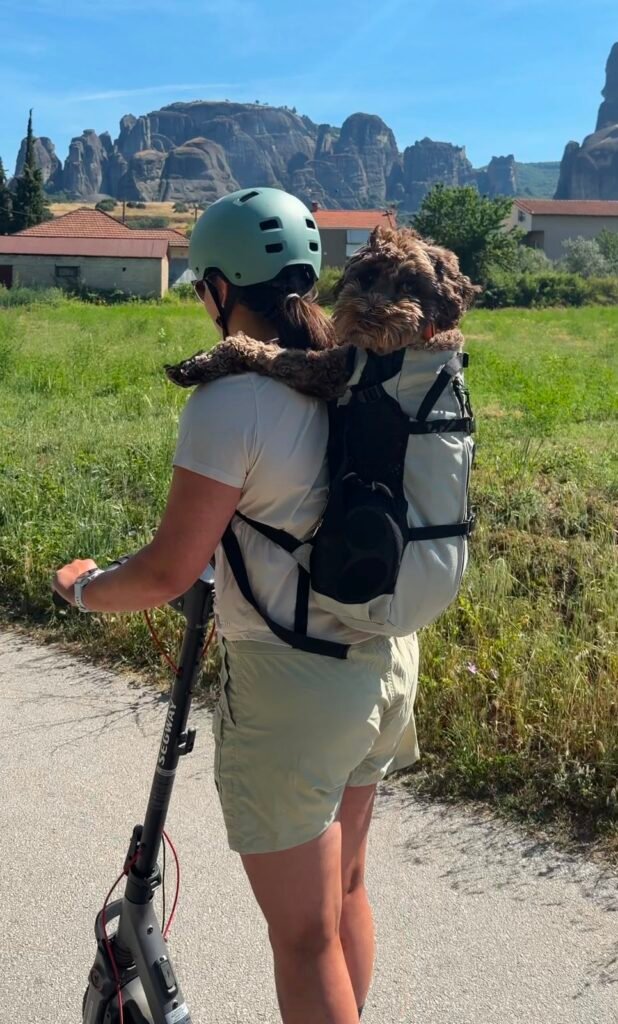
We use a K9 Sport Sack dog backpack that Bodhi gets into whenever we hop on the bike or the scooter.
Three reasons why this works better for us than a bike basket:
- Your hands stay free and the weight sits on your back instead of on the handlebars, which makes the bike a lot more stable.
- It also works on a scooter, where a basket isn’t an option.
- You can just keep walking as soon as you get off. You don’t have to rearrange anything if you park the bike and want to walk into town.
Keeping the heat in mind
It can get quite warm for your dog in a backpack, so keep the following in mind when buying and using one:
- Don’t use it during the hottest part of the day. Cycle in the morning or evening.
- When buying one, check whether the backpack has mesh panels so warm air can escape. Ideally, buy a light-colored backpack so it doesn’t heat up too much in the sun.
- Stop regularly to let your dog out and give them some water to drink.
Getting used to it
For most dogs, getting into a backpack is a big deal, so it’s important to let them get used to it slowly:
- Backpack open on the ground, let the dog sniff it, hide treats in the backpack.
- Backpack open on the ground, dog in it with a reward, straight back out again.
- Backpack closed, dog in it, you stay standing still.
- Backpack on your back, walk around the house or around the camper.
- Short bike rides on a quiet road.
- Only then head into traffic.
We got lucky that Bodhi is the easiest dog ever, because he hopped right in without any fuss!
Alternatives
If you don’t want a backpack at all, there are a few alternatives. Think of just letting them walk alongside the bike, as long as it’s not too hot and your dog is fit enough for it.
About that last point: dogs can keep up a cycling pace for longer than you’d think, and that’s exactly the problem. They won’t tell you when it’s becoming too much. On a hot day, walking alongside a bike on asphalt is one of the fastest ways to overheat a dog.
4 – Losing your dog abroad
Your dog doesn’t know the area while you’re traveling. That’s why it’s important to think about what you can do to prevent your dog from getting lost!
GPS tracker for your dog abroad
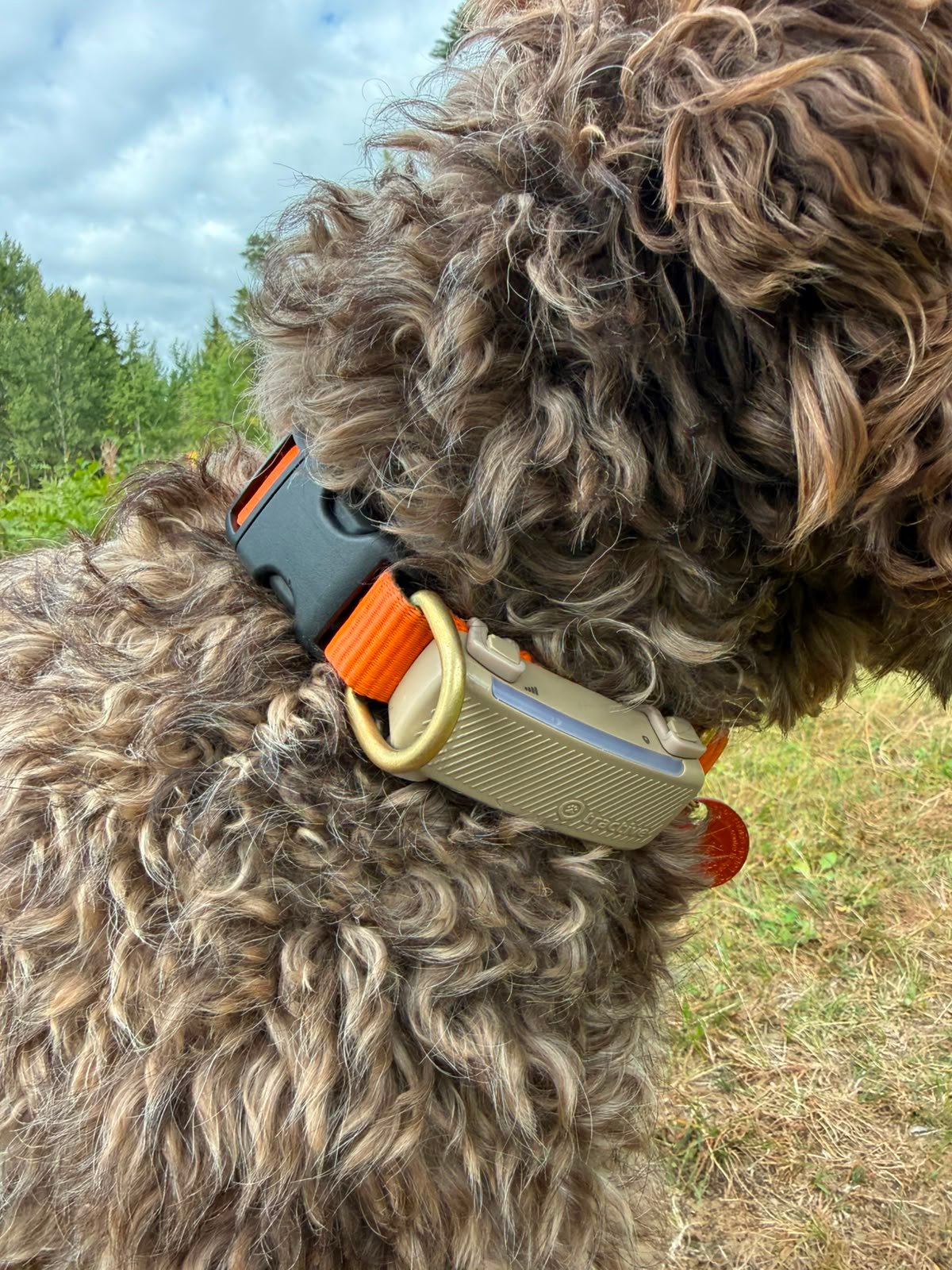
Since we do a lot of wild camping and Bodhi just roams free at those spots, we like that he has a GPS tracker.
We use a tracker from Tractive. A small tracker that clips easily onto the collar, with its own built-in SIM card, so it works wherever there’s mobile coverage. You do need a subscription for it though!
It comes with an app that lets you follow your dog live, and also look back at their history. In the app you even get to see health data for your dog: breathing, barking, daily activity, etc.! The tracker is waterproof and needs to be charged roughly once every 5 days (unless you have wifi in your camper, in which case it lasts about two weeks). Through the app you can also play a sound or turn on a light so you can find your dog even faster. The light is of course also super handy while walking them at night. If you’re really on top of it, you can train your dog to come back to the camper whenever they hear the sound!
We’ve lost Bodhi at the campsite a few times (a lot of campsites in the Balkans don’t mind if your dog just roams free) and were able to quickly track him down with the Tractive! Especially handy when you don’t want to shout across the whole campsite at night.
Phone number
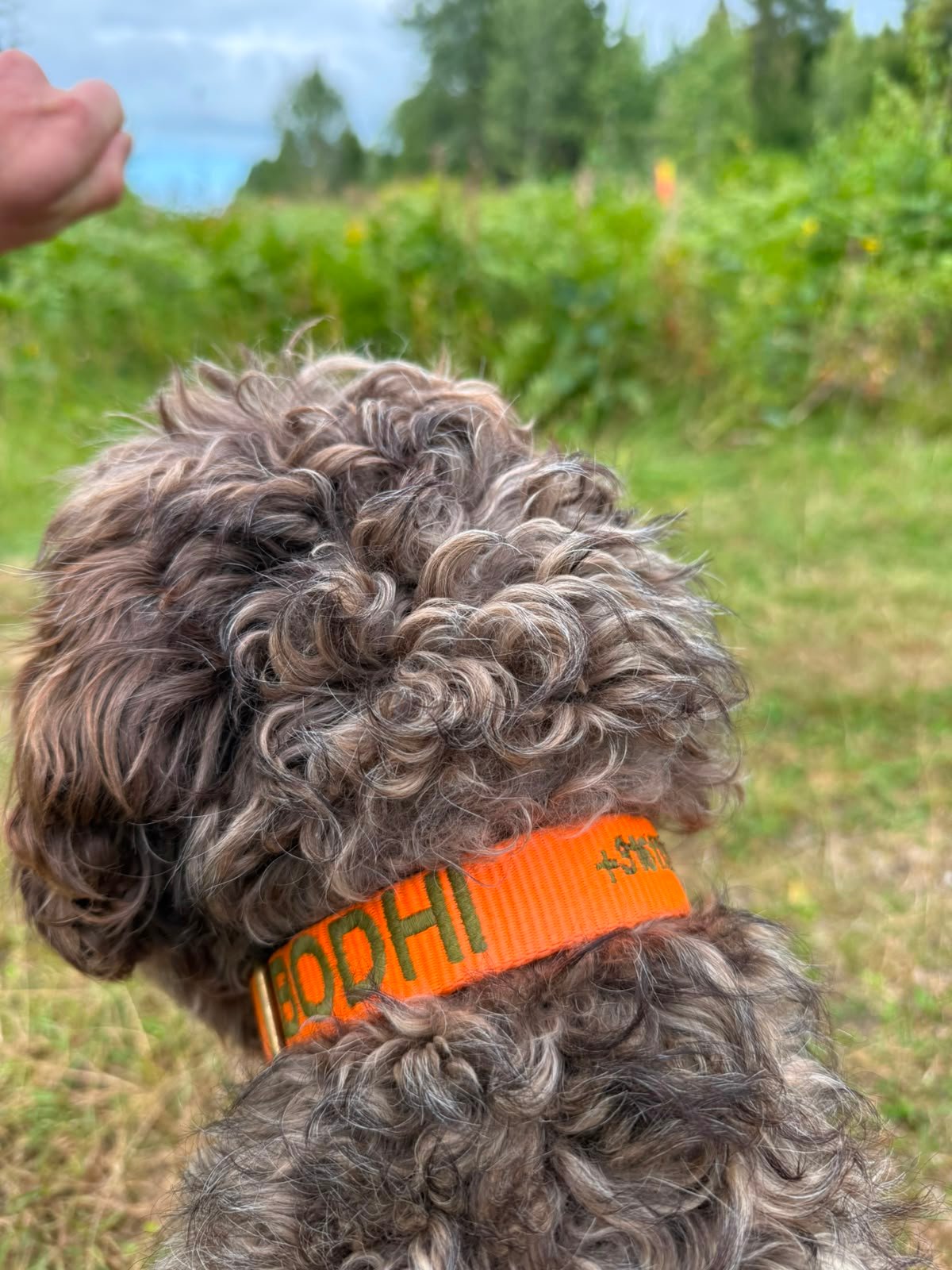
A small effort, but a big difference: make sure your phone number is visible if someone finds your dog. This can be done by having a tag/badge engraved, a capsule with room for a slip of paper, or by having it embroidered into the collar. Just make sure you put your international phone number on it! So +31 and not a domestic number. And if there are two of you traveling, put both numbers on it!
If you like, it’s also handy to add the country you’re from, so it’s immediately clear it’s not a local stray.
Everyone we meet wants to know where Bodhi’s collar is from! We got ours from Charlie and Jones and had Bodhi’s name and our phone number embroidered on it. It’s bright orange so he’s easy to spot, since Bodhi himself certainly isn’t 😉
5 – Muzzles: where are they mandatory?
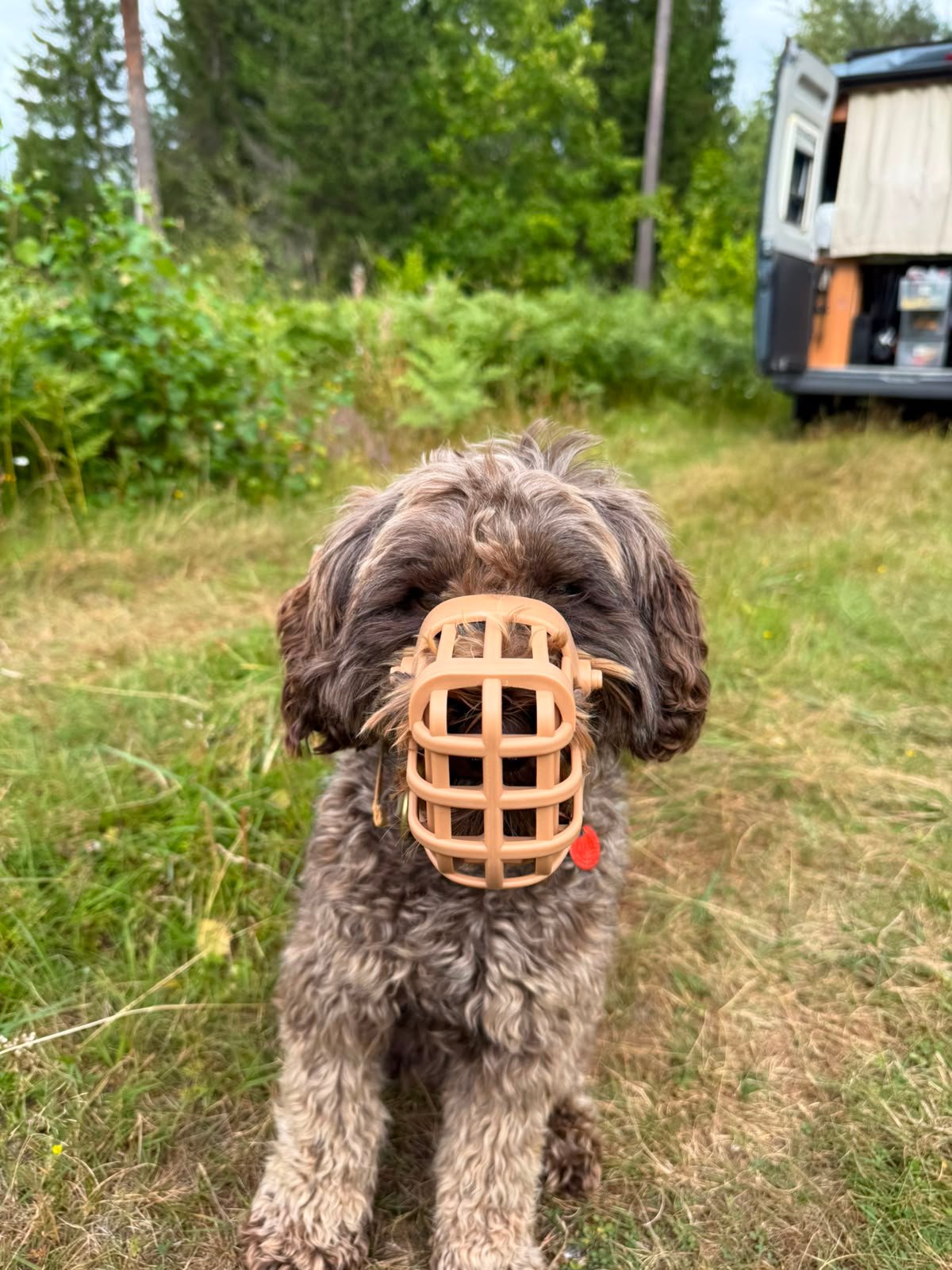
In various European countries a muzzle is mandatory on public transport, and sometimes even for certain breeds in certain cities or regions. The rules vary a lot per country and sometimes even per region within a country.
During our travels we noticed it’s not heavily enforced in most countries, but of course Bodhi doesn’t exactly look like a dangerous dog! We can imagine a pitbull or rottweiler getting asked to put one on sooner.
If you travel with the camper often, it’s a good idea to get one regardless – you never know when you’ll need it. We always bring ours!
Two things to keep in mind:
- Get a basket muzzle, not a nylon strap that clamps the mouth shut. A dog MUST be able to pant and drink. If you buy a muzzle where the dog can’t open its mouth at all, this becomes seriously dangerous in warm weather, since they can no longer pant to release heat. It’s best to just go to a pet store and find the right size together with a staff member.
- Train it at home, well before you need it. Your dog will need to get used to the muzzle. So train at home with putting the muzzle on. Do this in several short sessions spread over a number of days/weeks. First let your dog sniff the muzzle and reward them for it, then build it up by placing treats inside the muzzle. Once your dog is fully comfortable with the weird thing, you can carefully put it on briefly and reward well. Then gradually leave it on longer each time, always rewarding your dog well.
Bodhi already practiced with the muzzle during his puppy training course, so he had little trouble with it!
6 – Health risks in Southern Europe
In Southern Europe dogs face risks like leishmaniasis, heartworm and tick-borne diseases that are barely a concern in the Netherlands. You need to take preventive measures for these before you leave.
Which prevention is right depends on your dog, your route and the season. So discuss this with your vet!
What follows is meant to give you an idea of what to ask about, not as medical advice.
Ticks and fleas
While traveling by camper your dog is outside a lot, so check them thoroughly and often for ticks and fleas. For a long-haired dog that really means running your fingers through the coat, especially around the ears, neck, armpits, groin and between the toes. Try to get into the habit of doing this regularly!
A good tick remover or tick hook belongs in the camper, and ideally one in the walking bag too. Remember to twist the tick out, not pull it! Keep an eye on the spot for a few days afterward to see if it doesn’t show any abnormalities.
For prevention you can choose from spot-ons, tablets and collars. Important difference: some products only kill the tick after it has bitten, others repel it. For Southern Europe you’ll want a product with a repellent effect for the reason below.
Leishmaniasis in dogs in Southern Europe
Leishmaniasis is a serious infectious disease transmitted by sand flies, found throughout the Mediterranean region, including the Balkans, Italy, Greece, Spain and Portugal. The disease is chronic and can’t be cured, only suppressed. Serious business, in other words!
Sand flies are small midges that are active around sunset and at night. Symptoms can appear months to years after the bite, so you won’t necessarily notice right away that something’s wrong. The symptoms show up in various ways:
- Bald patches around the eyes (the “glasses” pattern), extreme skin flaking, sores on the ears, and abnormally fast-growing nails.
- Weight loss (despite eating well), extreme lethargy, swollen lymph nodes, and eventually life-threatening kidney failure (excessive drinking and urinating).
Here’s what you can do about it:
- A collar or spot-on with a repellent agent that specifically works against sand flies. Ask your vet which product is best and how long it lasts.
- There’s also a vaccine. It doesn’t offer full protection and doesn’t replace the repellents, but it can be part of the approach. Discuss this with your vet too, to see if it makes sense in your case.
- Fine-mesh screens for the windows and the skylight. Sand flies are tiny, so standard mosquito netting isn’t enough.
- Keeping your dog inside around sunset in areas where this is a risk. That’s exactly the moment you’ll want to be sitting outside yourself, so it takes some discipline.
Heartworm
This worm is transmitted by mosquitoes, mainly in Southern Europe. Prevention involves a monthly treatment prescribed by your vet. If you’re traveling through Southern Europe for a while, this is worth discussing!
Processionary caterpillars
These little creatures aren’t just a nuisance in the Netherlands – they’re also found across a large part of the rest of Europe. The urticating hairs of these caterpillars cause such severe inflammatory reactions that a dog sniffing or licking them can lose part of its tongue! So be extremely careful around these caterpillars!
Don’t walk a sniffing dog under pine trees where you see nests or caterpillar trails. They move in a recognizable line, one after another, along the ground.
Poisoned bait
In some places in Southern and Eastern Europe, poisoned bait is put out, intended to kill stray dogs or predators. Does your dog eat anything that isn’t nailed down? Then pay extra close attention in these areas! And ideally keep them on a leash. Handy tip: train the word “no” with your dog so you can call them back if you see them sniffing at some food.
Stray dogs
In the Balkans we came across a lot of loose stray dogs, and you’re likely to run into strays in other parts of Southern Europe too. Stray dogs can carry diseases or parasites that are new to your dog. So make sure your dog stays well away from stray dogs. And of course make sure the rabies vaccination is up to date no matter what.
Before our trip to the Balkans we were quite scared of aggressive stray dogs, but in the end we only ever ran into super sweet ones. We often gave them some of Bodhi’s food too!
7 – First aid kit for your dog: complete packing list
Maybe not the first thing you think of, but if you like having a first aid kit for yourself, why not one for your dog too?
Below you’ll see all the items we have in our first aid kit for Bodhi:
- Tick remover or tick hook (2x)
- Sterile gauze and self-adhesive bandage
- Wound spray or disinfectant for animals
- Tweezers
- Scissors
- Thermometer
- Paw protection or sock
- Syringe (without needle) for rinsing wounds or eyes
- Sterile saline solution
- Nail clippers and styptic powder
What doesn’t belong in it: human painkillers. Paracetamol and ibuprofen are toxic to dogs. So never give these to your dog!
8 – Keeping your dog entertained in the camper
A happy dog is a dog that can burn off its energy well. Usually plenty of walking and running is enough, but on days when that’s not possible we need to come up with something else. Otherwise you end up with a dog with too much pent-up energy in a small space. That shows up as restlessness, barking for no reason, and poor sleep.
That’s why it’s good to challenge your dog mentally, so they can burn off energy in a different way. Sniffing and chewing tire a dog out faster than walking, and they don’t take up any space. Here are some things you could do or bring to let your dog sniff and chew to their heart’s content:
- Snuffle mat or snuffle cloth. You hide food in the mat and your dog then searches it back out. A fun game that keeps them busy for a few minutes! A free alternative is rolling some kibble up in a towel (and tying it shut to make it even harder). We use this snuffle mat.
- Hiding food outside the camper. Walk a loop around the camper and lay a trail of kibble, so your dog is happily busy sniffing and hunting for a few minutes.
- Kong or fillable toy, optionally filled and frozen if you have a freezer. Extra handy in warm weather!
- Chews. A dog loves to chew! We always carry a stock of veggie sticks and cow skin chews with us!
- Fixed routines. Dogs love rhythm. Make sure you build roughly the same feeding times and walking moments into your routine.
Leaving your dog alone in the camper
When you’re traveling, you’ll occasionally want to go to a restaurant, a museum, or a supermarket where dogs aren’t allowed. That only goes well if your dog can be alone in the camper without whining or barking, and that’s something you train at home, not on the spot.
Start small: five minutes, then ten, then longer. Check that it’s really going well, because a dog that barks the moment you leave often falls silent again the moment you come back. On a busy campsite, a barking dog also quickly becomes a problem with the neighbors.
We use an old phone as a webcam to keep an eye on Bodhi whenever we’re out for a bit!
9 – Keeping the camper livable
Yes, this might be the one downside of traveling with your dog… It gets dirty and wet inside pretty fast if your dog does too. Think about the following before you leave:
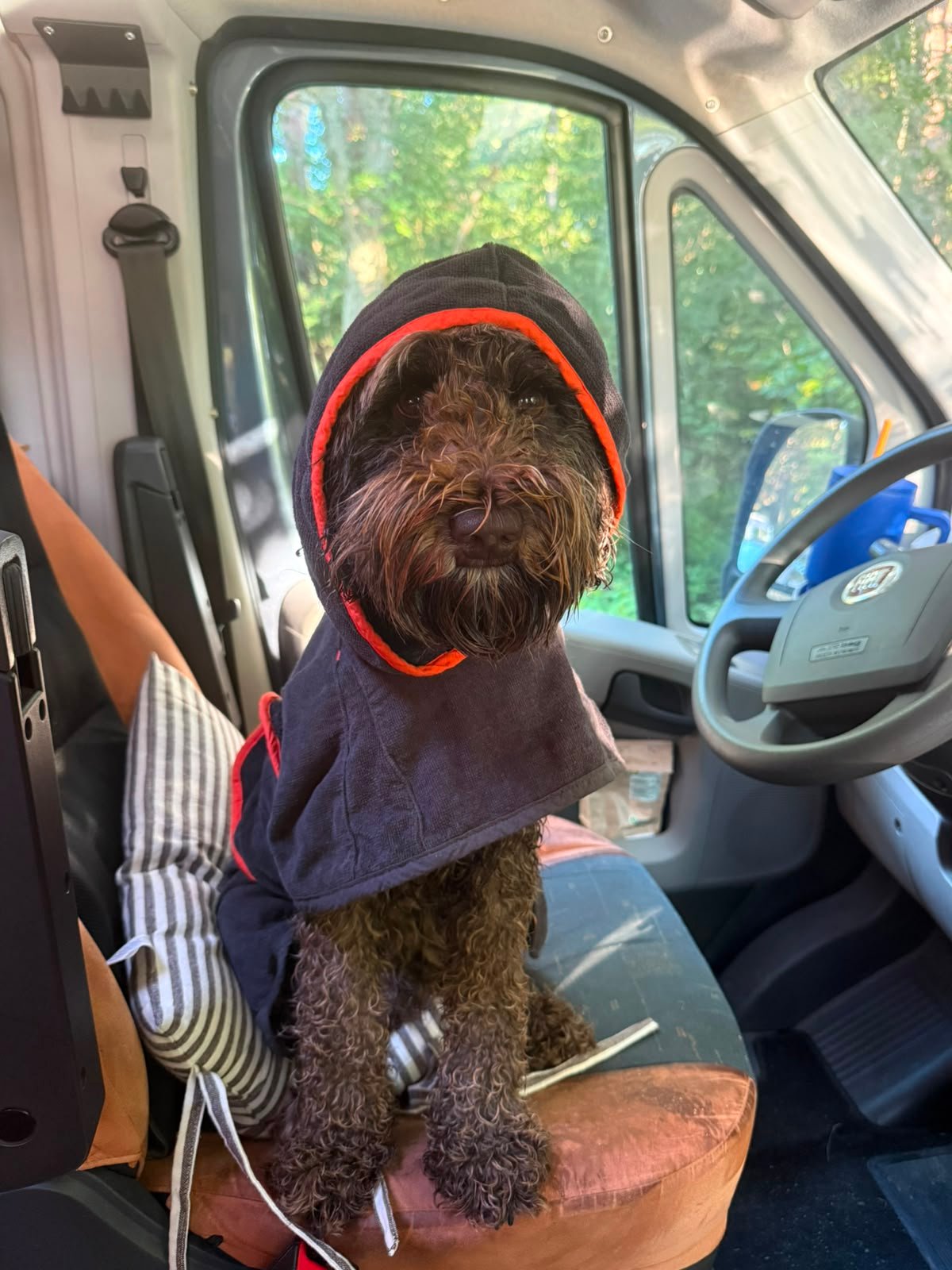
Dog bathrobe. An absorbent dog bathrobe that you put on after a beach walk, a rain shower, or a swim. Your dog dries underneath it and your camper stays dry. This sounds like a gimmick until you’ve had a wet labradoodle in a six-meter camper. We always dry Bodhi off as best we can with his towel first, and then he gets his bathrobe on so he can walk freely through the camper without getting everything wet right away.
Towels and where they dry. You need more of them than you think, and the real problem isn’t the drying-off itself but drying the towel afterward. Think carefully about where you’ll put the dirty, wet towel when it’s raining outside.
Vacuum cleaner. Even without a dog you shouldn’t be without one, but with a dog you’ll need it even more often. We picked one that’s easy and quick to charge via USB-C, since it gets used a lot!
Bed. In most campers the bed is pretty accessible for your dog. The last thing you want is your wet or dirty dog jumping on the bed! So think about whether you can close off your bed to your dog. If that’s not possible, it’s smart to lay a throw or something similar over your bed. We use our outdoor blankets for this, which are easy to shake out.
Entrance mat. Possibly the best upgrade we’ve made is cutting a large entrance mat to size at the door. This saves us so much mess inside! Bodhi gets dried off on the mat, then gets his bathrobe on, and only then is allowed further into the camper!
Hair dryer or doodle blower. If your inverter is big enough, you can even bring a hair dryer or doodle blower! Not just handy for blowing your dog dry, but also for blowing the sand out of their coat.
Need more camper gear tips? Also check out our 5 must-haves for the camper.
Food and gear on the road
Food and storage. Bring enough food if your dog is on a specific brand or diet, since you can’t assume it’ll be available everywhere. Store it airtight: moisture and heat aren’t good for kibble, and an open bag attracts pests.
Poop bags. Bring plenty! In parts of Southern and Eastern Europe they’re not always sold in the supermarket by default. We use biodegradable bags ourselves, so we can bury them occasionally when needed too.
10 – Checklist: traveling with a dog in a camper
Arranging in advance
- Chip registered and linked to the passport
- Rabies vaccination valid, given at least 21 days before departure
- Other vaccinations
- Rabies titer test done in the Netherlands (if applicable)
- Insurance checked for coverage abroad and duration
- Tag with international phone number
- Muzzle trained
- Backpack trained
- Being alone trained
In the camper
- Maxxfan or another roof fan
- Cooling mat
- Dog backpack
- Throw/blanket over the bed
- Hair dryer / doodle blower
- Temperature sensor / thermometer + webcam
- Fine-mesh screens
- Window insulation or blackout
- Crate or crash-tested harness
- GPS tracker
- Water bowl inside and a foldable one for on the go
- Storage container for kibble
- USB-C rechargeable vacuum cleaner
Care and safety
- Tick remover, at least two
- Prevention against ticks, fleas and sand flies, in consultation with the vet
- Heartworm prevention if applicable
- First aid kit for the dog
- Basket muzzle
Against boredom
- Snuffle mat
- Kong or fillable toy
- Chews
Wet and dirty
- Dog bathrobe
- Towels and a place to dry them
- Entrance mat
- Poop bags, plenty
11 – Frequently asked questions
Did you find this blog useful? Follow us on Instagram for more handy travel tips!